
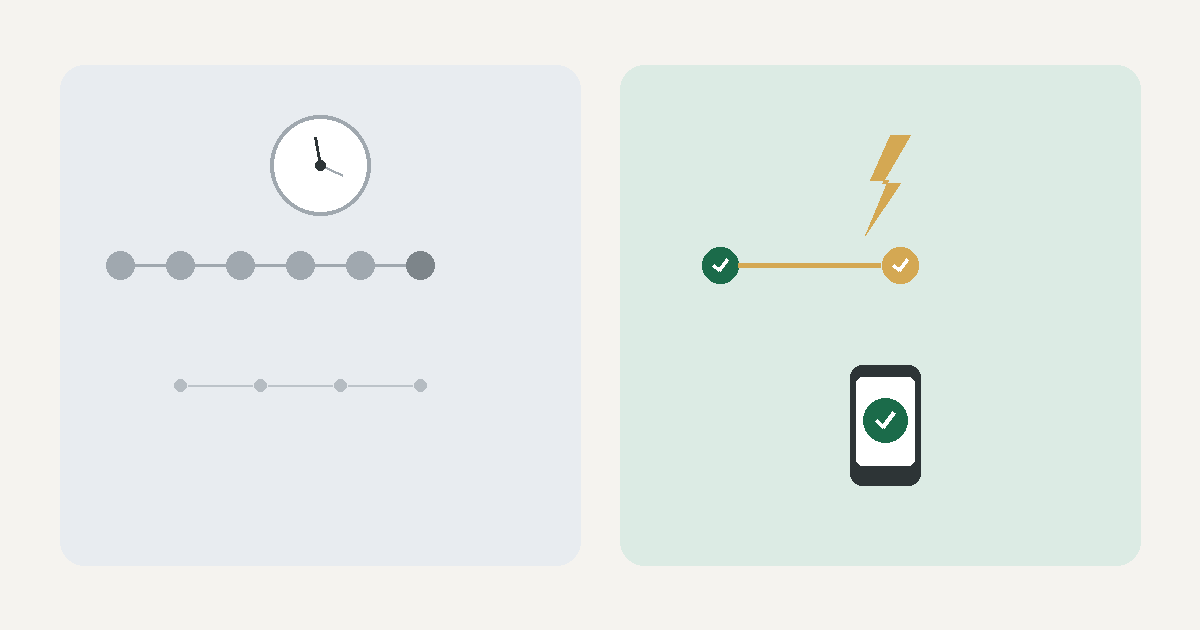
When you borrow for a time-sensitive expense, “when will the money arrive?” is often as important as “how much can I get?” Standard bank transfers work well for many people, but they follow banking-day schedules that can stretch across evenings, weekends, and holidays. Real-Time Funding—sometimes discussed alongside instant or faster disbursement options—is designed to shorten that wait when banking networks and your bank support it.
This article explains what Real-Time Funding means in plain language, how it differs from ACH, when faster funding tends to matter most, what your bank controls, how to check whether instant deposits are realistic for your account, and how fees work. Little Lake Lending does not charge a fee for Real-Time Funding; your bank might. For step-by-step application timing and cutoff details, see the practical timeline on our Apply page.
Faster funding is a convenience feature, not a reason to borrow more than you need. Approval is still required, you still must sign your agreement, and availability is never guaranteed.
What Real-Time Funding Is
In consumer lending, Real-Time Funding generally refers to a disbursement method that can move funds to your checking account faster than a standard ACH transfer. Instead of waiting for the next banking-day ACH window, the transfer may post more quickly when the lender, the payment network, and your bank all support the faster path.
Important boundaries:
- Real-Time Funding is typically considered after you are approved and you have signed your loan agreement
- It is not a promise of instant approval
- It is not available in every case, even if you request it
- It depends on banking factors outside any one lender’s full control
Think of it as an optional delivery method for funds you are already approved to receive—similar to choosing expedited shipping after you have already placed an order, except the “carrier” is the banking system and your bank’s rules.
ACH vs. Real-Time Funding
ACH (Automated Clearing House) is the workhorse of everyday bank transfers in the United States. Payroll deposits, many bill payments, and standard loan disbursements often travel by ACH. ACH moves in batches and follows banking-day conventions. In practice, that means:
- Signing and submitting early on a business day often supports next-business-day arrival
- Signing after an evening cutoff, or on a weekend or federal banking holiday, can push initiation to the next business day
- Your bank’s posting rules can add time even after a transfer is sent
Little Lake Lending’s Apply page explains the company’s ACH approach in operational terms, including the 6:00 PM CST weekday cutoff concept and how weekends and holidays are treated. Those details belong on the application timeline page; what matters conceptually is that ACH is reliable but calendar-aware.
Real-Time Funding aims to reduce that calendar friction when it is available. Funds may post faster than standard ACH—sometimes much faster—because the transaction uses rails and bank capabilities built for quicker credit to your account. The tradeoff is variability: not every bank, account type, or card-linked pathway supports faster credits the same way.
| Feature | Standard ACH | Real-Time Funding (when available) |
|---|---|---|
| Typical speed | Often next business day after timely initiation | Faster posting possible, sometimes much sooner |
| Evening / weekend sensitivity | High—cutoffs and non-business days matter | Designed to help when waiting for the next banking day is painful |
| Dependence on your bank | Yes | Yes—often more visibly, because support varies |
| Guaranteed? | Timing still depends on banks | No—availability is not guaranteed |
| LLL fee | Disbursement method choice is not sold as an extra LLL fee for RTF | Little Lake Lending does not charge a fee for Real-Time Funding |
Neither method changes your loan balance, interest, or payment schedule. They change delivery speed and, potentially, bank-side fees—not the core credit contract.
When Faster Funding Matters Most (Evenings, Weekends, Holidays)
People usually care about Real-Time Funding when the banking calendar works against them:
- You complete signing after about 6:00 PM CST on a weekday, when standard ACH initiation may already be timed for the next business day
- You complete signing on a Saturday, Sunday, or federal banking holiday, when ACH timelines typically wait for the next business day
- You have a bill due before the next business-day deposit would land
- You need clarity sooner so you do not bounce a payment you planned around funds that have not arrived yet
Even then, faster funding is only relevant after approval and signing. If verification is still pending, or you have not signed, disbursement—fast or slow—has not started. Rushing through documents to chase speed is a poor trade. Read the agreement first; then choose a funding path.
For the operational cutoff language and what “next business day” means in Little Lake Lending’s process, use the Funding Timeline section on Apply. This article explains the concept; that page explains the practical schedule.
Bank-Side Factors You Do Not Control
Lenders can initiate a transfer and still not control everything that happens next. Common bank-side factors include:
- Whether your bank participates in the faster-payment pathway being used
- Account type restrictions (some accounts accept standard ACH but block or delay certain faster credits)
- Fraud controls and holds that temporarily limit access to incoming funds
- Name or account mismatches that cause returns or delays
- Network or processor downtime
- Debit-card or account-verification requirements some faster methods use
If funds do not appear when you expected, check your account activity first, confirm you are looking at the correct account, and then contact the lender with your application or loan reference so they can confirm whether a transfer was sent. Do not spend money you have not actually received, and do not write checks against a pending deposit until it posts and is available under your bank’s rules.
How to Check Whether Your Bank Supports Instant or Faster Deposits
Before you count on Real-Time Funding, do a little homework:
- Search your bank’s help center for terms like “instant deposits,” “real-time payments,” “RTP,” “faster payments,” or “push to card” (wording varies).
- Ask customer service whether your specific checking account can receive faster credits from third parties, and whether any fee applies.
- Confirm account eligibility. Joint accounts, new accounts, savings accounts, or accounts in a restricted status sometimes behave differently than a standard open checking account.
- Keep your legal name aligned across your loan application and your bank account. Mismatches are a frequent cause of friction.
- Have debit-card details ready only if requested for a faster-funding path—and only through the lender’s secure process, never through a random text link.
Support can change over time. A bank that did not support faster credits last year might now, or vice versa. Availability on one loan does not guarantee availability on a future loan.
Fees: What Little Lake Lending Charges vs. What Your Bank Might Charge
Fee clarity matters because “free from the lender” and “free from your bank” are different sentences.
- Little Lake Lending does not charge a fee for Real-Time Funding. Choosing a faster disbursement method, when it is offered, is not an extra LLL surcharge for RTF.
- Your bank may assess its own fee for receiving certain faster deposits or related services. That fee, if any, is between you and your bank and should be confirmed with them.
- Your loan’s finance charges and APR disclosures are separate from disbursement-method fees. Read the agreement for the cost of credit itself.
If a faster option is not available for your bank, standard ACH remains the usual path. Slower is not “failed”—it is the default banking timeline.
Practical Tips While You Wait for Funds
- Keep your login and contact info current so you can complete signing without delay once approved
- Watch for verification requests; funding cannot start until required checks are done
- After signing, monitor the account you listed on the application—not a different account you meant to use
- If you elected Real-Time Funding and nothing posts, allow a reasonable window, then contact support with details rather than re-applying elsewhere in a panic
- Budget as if funds arrive on the slower ACH schedule until you see the deposit available
Speed reduces waiting. It does not reduce your obligation to repay on schedule once funded.
Conclusion
Real-Time Funding is a faster disbursement option that may be available after approval and signing when banking networks and your bank support it. It differs from ACH mainly in speed and in how sensitive timing is to evenings, weekends, and holidays. Availability depends on banking factors, it is not guaranteed, and while Little Lake Lending does not charge a fee for Real-Time Funding, your bank might.
For cutoff times, weekend handling, and the step-by-step path from application to funding, review the timeline on our Apply page so you can plan with clear expectations.